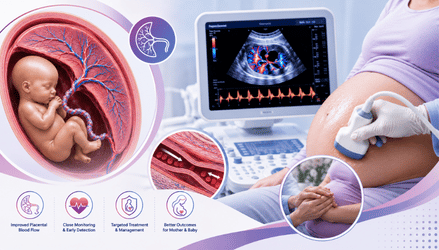
Advanced Monitoring & Specialized Care for Healthy Pregnancy Outcomes
Placental insufficiency can affect the flow of oxygen and nutrients from the placenta to the baby, making timely diagnosis and close monitoring essential. At Sattva The Fetal Medicine Centre, we provide comprehensive Placental Insufficiency Management through advanced fetal assessments, Doppler ultrasound, growth monitoring, and individualized pregnancy care to support the health of both mother and baby.
Our goal is to detect potential concerns early, closely monitor fetal well-being, and provide evidence-based care that helps improve pregnancy outcomes while ensuring personalized support throughout your pregnancy journey.
Placental insufficiency may develop due to several maternal health conditions and pregnancy-related factors that reduce the supply of oxygen and nutrients to the baby. Early identification of these risk factors allows for closer monitoring, timely intervention, and improved pregnancy outcomes.
Placental insufficiency does not always cause noticeable symptoms, especially in the early stages. However, recognizing the warning signs and seeking prompt medical evaluation can help protect both maternal and fetal health through timely diagnosis and specialized pregnancy care.
A noticeable decrease in your baby's movements may indicate reduced oxygen or nutrient supply and requires immediate medical assessment.
The baby may not grow as expected due to insufficient placental function, requiring regular growth monitoring.
Maternal hypertension is a common condition associated with placental insufficiency and requires close monitoring.
Ultrasound scans may show restricted fetal growth or delayed development, indicating the need for specialized care.
Reduced amniotic fluid can be associated with poor placental function and requires careful pregnancy monitoring.
Doppler studies can identify abnormal blood flow between the placenta and baby, helping guide timely intervention.
Conditions such as preeclampsia may develop alongside placental insufficiency and require specialized maternal-fetal care.
At Sattva The Fetal Medicine Centre, we use advanced ultrasound technology, Doppler studies, fetal growth monitoring, and personalized maternal-fetal care to diagnose placental insufficiency early and support healthy pregnancy outcomes.
Placental insufficiency can reduce the supply of oxygen and nutrients to the developing baby. Without appropriate monitoring and timely management, it may increase the risk of several maternal and fetal complications. Early diagnosis and specialized care help reduce these risks and improve pregnancy outcomes.
Reduced placental function may limit the baby's growth, resulting in fetal growth restriction (FGR/IUGR).
Babies affected by placental insufficiency may have a lower-than-expected birth weight due to restricted growth.
Early delivery may become necessary if continuing the pregnancy poses a greater risk to the mother or baby.
Placental insufficiency can lead to decreased amniotic fluid levels, requiring close monitoring.
Reduced oxygen and nutrient supply may affect fetal well-being and require urgent medical intervention.
Placental insufficiency is often associated with preeclampsia, a serious pregnancy complication involving high blood pressure.
In severe untreated cases, placental insufficiency may increase the risk of stillbirth, making close fetal monitoring essential.
If maternal or fetal health becomes compromised, an emergency delivery may be required to ensure the safest possible outcome.
Placental insufficiency can sometimes progress without obvious symptoms. If you experience any of the following warning signs during pregnancy, contact your healthcare provider immediately for prompt evaluation and appropriate medical care.
A noticeable decrease in your baby's movements may indicate reduced fetal well-being and requires urgent medical assessment.
Any vaginal bleeding during pregnancy should be evaluated immediately by your healthcare provider.
Persistent or severe abdominal pain may indicate a pregnancy complication requiring urgent medical attention.
A severe or persistent headache may be a sign of high blood pressure or preeclampsia and should never be ignored.
Sudden changes in vision require immediate medical evaluation as they may indicate a serious pregnancy complication.
Rapid swelling may be associated with preeclampsia and requires prompt medical assessment.
A sudden gush or continuous leakage of fluid should be evaluated immediately to rule out rupture of membranes.
Regular or painful contractions before your due date may indicate preterm labour and require urgent medical attention.
Symptoms such as severe headache, dizziness, blurred vision, or elevated blood pressure should be assessed without delay.
Find answers to common questions about placental insufficiency, diagnosis, monitoring, treatment, and pregnancy management at Sattva The Fetal Medicine Centre.
Placental insufficiency occurs when the placenta is unable to deliver enough oxygen and nutrients to the developing baby. This may affect fetal growth, development, and overall pregnancy outcomes.
While the placenta itself cannot be repaired, careful monitoring, appropriate medical management, and timely intervention can help reduce complications and improve pregnancy outcomes.
Yes. Women with placental insufficiency generally require more frequent ultrasound examinations, growth scans, and Doppler studies to monitor fetal development and placental blood flow.
The mode of delivery depends on maternal health, fetal well-being, gestational age, and pregnancy progression. Your maternal-fetal medicine specialist will recommend the safest delivery option for you and your baby.
Not always. With early diagnosis, regular fetal monitoring, Doppler surveillance, and specialized pregnancy care, many women with placental insufficiency go on to have successful pregnancies and healthy babies.