Early Prenatal Screening for Informed Pregnancy Care
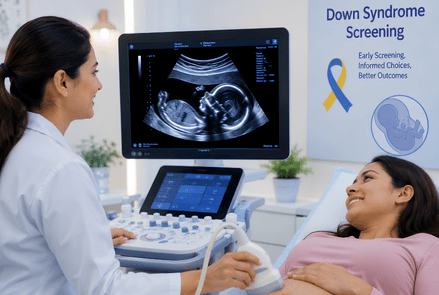
Down Syndrome Screening is an important prenatal screening that helps estimate the likelihood of a baby having Down syndrome (Trisomy 21). At Sattva The Fetal Medicine Centre, we provide comprehensive Down Syndrome Screening through advanced ultrasound, NT Scan, First Trimester Screening, and personalized maternal-fetal care. Our goal is to provide accurate risk assessment, early reassurance, and expert guidance throughout your pregnancy.
What is Down Syndrome Screening?
Down Syndrome Screening is a non-invasive prenatal screening performed during pregnancy to estimate the probability that the baby may have Down syndrome (Trisomy 21). It combines maternal age, ultrasound findings, and blood test results to calculate an individual risk.
It is important to understand that this is a screening test, not a diagnostic test. A screening result indicates whether the likelihood is higher or lower than expected.
If the screening suggests an increased chance, your healthcare provider may recommend further diagnostic testing to confirm the diagnosis and provide appropriate counselling and pregnancy management.
Early prenatal screening helps families understand their pregnancy, assess the likelihood of chromosomal conditions, and make informed decisions about further evaluation and personalized pregnancy care.
At Sattva The Fetal Medicine Centre, comprehensive prenatal screening helps estimate the likelihood of common chromosomal abnormalities and supports early identification of pregnancies that may benefit from additional evaluation, genetic counselling, or diagnostic testing.
The primary focus of prenatal screening is to estimate the likelihood that the baby may have Down syndrome (Trisomy 21), the most common chromosomal condition screened during pregnancy.
Screening also evaluates the risk of Edwards syndrome (Trisomy 18), a rare chromosomal condition associated with serious developmental abnormalities.
Risk assessment includes screening for Patau syndrome (Trisomy 13), another uncommon chromosomal condition that can affect multiple organ systems.
Depending on individual circumstances, ultrasound evaluation may also assess for certain fetal structural abnormalities that require further investigation.
Additional assessments may help identify pregnancy-related concerns, supporting timely referral, personalized care, and appropriate follow-up throughout pregnancy.
At Sattva The Fetal Medicine Centre, we provide comprehensive Down Syndrome Screening services using advanced ultrasound technology, evidence-based prenatal screening, and expert maternal-fetal medicine care. Our goal is to deliver accurate risk assessment, early detection, personalized counselling, and ongoing pregnancy support for every expectant family.
Comprehensive evaluation to estimate the likelihood of Down syndrome (Trisomy 21) based on screening findings and maternal risk factors.
Nuchal Translucency (NT) Scan performed during the first trimester as an important component of prenatal chromosomal risk assessment.
Combined ultrasound and maternal blood test screening performed between 11 weeks and 13 weeks 6 days to assess chromosomal risk.
High-resolution ultrasound examination to evaluate early fetal development and support comprehensive prenatal screening.
Thorough evaluation of fetal anatomy and development to identify any significant structural findings.
Personalized counselling to help parents understand the purpose, benefits, and limitations of prenatal screening.
Expert guidance for interpreting screening results and discussing further diagnostic testing when indicated.
Individualized risk assessment based on maternal age, medical history, ultrasound findings, and laboratory screening results.
Specialized maternal-fetal evaluation and monitoring for pregnancies requiring additional clinical attention.
Tailored pregnancy management plans based on screening outcomes, maternal health, and individual pregnancy needs.
Ongoing follow-up with repeat assessments and specialist care to support a healthy pregnancy from screening through delivery.
Find answers to common questions about Down Syndrome Screening, First Trimester Screening, NT Scan, and prenatal risk assessment at Sattva The Fetal Medicine Centre.
No. Down Syndrome Screening is a screening test that estimates the likelihood of Down syndrome (Trisomy 21). Diagnostic tests such as Chorionic Villus Sampling (CVS) or amniocentesis are required to confirm the diagnosis when clinically appropriate.
It is generally performed between 11 weeks and 13 weeks 6 days of pregnancy as part of First Trimester Screening, which includes the NT Scan and maternal blood tests.
Yes. Down Syndrome Screening is safe and non-invasive. It involves an ultrasound examination (NT Scan) and maternal blood tests, without exposing the mother or baby to radiation.
No screening test can provide a 100% guarantee. However, a low-risk screening result is reassuring and indicates that the likelihood of Down syndrome is lower than expected.
If your screening result indicates an increased risk, your healthcare provider may recommend additional evaluation such as Non-Invasive Prenatal Testing (NIPT), CVS, amniocentesis, or a detailed fetal ultrasound, depending on your individual pregnancy and clinical findings.