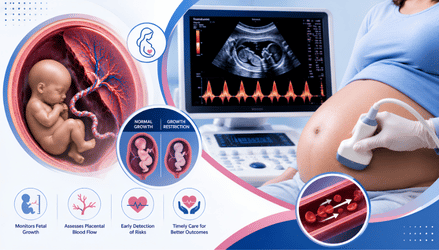
Advanced Monitoring & Personalized Care for Healthy Pregnancy Outcomes
Fetal Growth Restriction (FGR), also known as Intrauterine Growth Restriction (IUGR), requires careful monitoring to ensure the best possible outcomes for both mother and baby. At Sattva The Fetal Medicine Centre, we provide comprehensive Fetal Growth Restriction (IUGR) Management through advanced ultrasound imaging, Doppler studies, fetal well-being assessments, and individualized pregnancy care.
Our goal is to monitor your baby's growth closely, identify concerns early, and provide timely interventions that support a healthy pregnancy and safe delivery.
Fetal Growth Restriction (FGR/IUGR) can occur due to maternal health conditions, placental problems, or fetal factors that affect the baby's growth inside the womb. Early identification of these causes allows for timely monitoring and personalized pregnancy care to improve maternal and fetal outcomes.
Certain maternal health conditions and pregnancy-related factors increase the risk of Fetal Growth Restriction (FGR/IUGR). If you have any of these risk factors, regular fetal growth monitoring and specialized maternal-fetal care can help detect concerns early and improve pregnancy outcomes.
Women with high-risk pregnancies require close monitoring to ensure healthy fetal growth and well-being.
A history of FGR/IUGR increases the likelihood of recurrence in future pregnancies.
Placental abnormalities can reduce the baby's oxygen and nutrient supply, affecting growth.
High blood pressure before or during pregnancy increases the risk of fetal growth restriction.
Diabetes during pregnancy may affect placental function and fetal growth in some pregnancies.
Multiple pregnancies require additional surveillance because of a higher risk of growth restriction.
IVF pregnancies often benefit from specialized fetal growth assessments throughout pregnancy.
Advanced maternal age is associated with an increased risk of fetal growth complications.
Women with a previous stillbirth require close fetal surveillance in subsequent pregnancies.
Autoimmune conditions may affect placental blood flow and fetal growth during pregnancy.
Kidney disease during pregnancy increases the need for specialized maternal-fetal monitoring.
Reduced fetal growth detected on ultrasound requires detailed evaluation and ongoing monitoring.
At Sattva The Fetal Medicine Centre, we provide advanced fetal growth monitoring, Doppler ultrasound studies, fetal well-being assessments, and personalized pregnancy care for women at increased risk of Fetal Growth Restriction (IUGR).
Many women with Fetal Growth Restriction (FGR/IUGR) do not experience noticeable symptoms, making routine prenatal check-ups and ultrasound examinations essential. Early detection allows timely intervention and improves pregnancy outcomes for both mother and baby.
The uterus or baby's size may be smaller than expected for the stage of pregnancy, requiring further evaluation.
A noticeable decrease in your baby's movements should be assessed promptly by your healthcare provider.
Serial ultrasound scans may show that the baby is growing more slowly than expected.
Reduced amniotic fluid levels may accompany fetal growth restriction and require close monitoring.
Doppler studies may detect reduced blood flow between the placenta and the baby, indicating the need for specialized care.
High blood pressure during pregnancy is commonly associated with fetal growth restriction and requires ongoing monitoring.
Placental insufficiency and fetal growth restriction (IUGR) often develop without noticeable symptoms. Regular prenatal check-ups, ultrasound scans, and fetal monitoring are essential for early detection and timely management to protect both mother and baby.
Many women with IUGR do not experience obvious symptoms, making routine prenatal care extremely important.
Fundal height measurements may indicate that the baby is smaller than expected for the stage of pregnancy.
A noticeable decrease in your baby's movements may indicate reduced oxygen or nutrient supply.
Serial ultrasound scans may show that the baby's growth is slower than expected.
Reduced amniotic fluid levels can be a sign of placental insufficiency and require close monitoring.
Doppler studies may reveal reduced blood flow between the placenta and the baby.
High blood pressure or preeclampsia can increase the risk of placental insufficiency and fetal growth restriction.
At Sattva The Fetal Medicine Centre, we provide comprehensive maternal and fetal care for pregnancies affected by Fetal Growth Restriction (IUGR). Our personalized management approach combines advanced fetal monitoring, timely investigations, and expert guidance to support healthy pregnancy outcomes for both mother and baby.
A comprehensive evaluation of maternal health, pregnancy history, and fetal condition to develop an individualized care plan.
Regular ultrasound scans monitor fetal growth and detect any slowing of development at an early stage.
Evaluates blood flow between the placenta and baby to assess placental function and fetal well-being.
Precise fetal measurements help assess growth patterns and identify fetal growth restriction accurately.
Regular monitoring of amniotic fluid levels provides important information about fetal health and placental function.
Evaluates your baby's heart rate and movement patterns to ensure ongoing fetal well-being.
Combines ultrasound findings and fetal heart rate monitoring to assess your baby's overall health.
Continuous fetal surveillance helps detect changes early and supports timely medical intervention.
Regular blood pressure monitoring helps identify hypertension and preeclampsia, which can affect fetal growth.
Early detection and management of gestational diabetes help reduce pregnancy-related complications.
Personalized dietary guidance supports maternal health and promotes healthy fetal growth throughout pregnancy.
Every pregnancy receives a customized monitoring and treatment plan based on maternal and fetal needs.
Careful planning of the safest timing and mode of delivery to optimize outcomes for mother and baby.
Continued care after delivery supports maternal recovery and ensures appropriate follow-up for both mother and newborn.
Close fetal surveillance is essential in pregnancies affected by Fetal Growth Restriction (IUGR). Our maternal-fetal medicine specialists use advanced diagnostic techniques to monitor your baby's health, detect changes early, and provide timely intervention for the best possible pregnancy outcome.
Close monitoring allows timely identification of fetal concerns, enabling early intervention and improving pregnancy outcomes.
Regular ultrasound examinations monitor your baby's weight, growth pattern, and overall development throughout pregnancy.
Doppler studies evaluate blood flow between the placenta and baby to assess placental function and fetal well-being.
Measures your baby's heart rate and its response to fetal movements to assess oxygenation and overall health.
A comprehensive assessment that evaluates fetal breathing, body movements, muscle tone, heart rate, and amniotic fluid levels to determine your baby's well-being.
Management of Fetal Growth Restriction (IUGR) depends on your baby's growth pattern, gestational age, maternal health, and placental function. Our maternal-fetal medicine specialists provide individualized monitoring and evidence-based care to support a safe pregnancy and healthy delivery.
Regular antenatal appointments allow close monitoring of maternal health and your baby's growth throughout pregnancy.
Repeated ultrasound examinations help track fetal growth and identify any changes that require intervention.
Doppler ultrasound evaluates blood flow between the placenta and baby to monitor placental function and fetal well-being.
Careful monitoring and treatment of high blood pressure help reduce pregnancy complications and improve placental health.
Managing gestational or pre-existing diabetes supports healthy fetal growth and lowers pregnancy-related risks.
Personalized nutritional counselling helps optimize maternal health and provides the nutrients needed for fetal development.
Activity modification and adequate rest may be recommended to support placental function and fetal well-being.
Hospital admission may be advised in high-risk pregnancies for continuous maternal and fetal monitoring.
When necessary, delivery is carefully planned at the safest time based on fetal growth, gestational age, and maternal condition.
Without proper monitoring and timely medical care, Fetal Growth Restriction (IUGR) may increase the risk of several pregnancy and newborn complications. Early diagnosis, close fetal surveillance, and specialized maternal-fetal medicine care can significantly improve pregnancy outcomes for both mother and baby.
Babies with IUGR are more likely to have a lower-than-expected birth weight due to restricted growth.
Early delivery may be required when continuing the pregnancy poses a greater risk to the mother or baby.
Reduced placental function may affect your baby's oxygen supply and overall well-being during pregnancy or labour.
Insufficient blood flow through the placenta may reduce oxygen delivery to the developing baby.
Placental insufficiency can lead to decreased amniotic fluid, requiring close monitoring throughout pregnancy.
In severe untreated cases, IUGR may increase the risk of stillbirth, making regular fetal monitoring essential.
Some babies may require specialized newborn care due to breathing difficulties, feeding problems, or low blood sugar.
If maternal or fetal health becomes compromised, urgent delivery may be necessary to ensure the safest possible outcome.
Early diagnosis and specialized care significantly improve pregnancy outcomes for both mother and baby.
At Sattva The Fetal Medicine Centre, we follow a structured, evidence-based approach to diagnose, monitor, and manage Fetal Growth Restriction (IUGR). Our personalized care pathway ensures continuous fetal surveillance, timely intervention, and comprehensive support throughout pregnancy to achieve the best possible outcomes for both mother and baby.
A detailed review of your medical history, pregnancy history, and current pregnancy assessment to identify individual risk factors.
Advanced ultrasound examination, Doppler studies, and fetal health assessment to evaluate placental function and fetal growth.
A customized follow-up schedule with fetal monitoring, ultrasound scans, and prenatal visits based on your pregnancy progress.
Regular fetal growth scans, Doppler surveillance, and maternal health evaluations help ensure timely intervention whenever needed.
Planning the safest timing and mode of delivery based on fetal well-being, gestational age, and maternal health.
Continued care for both mother and baby after delivery, including recovery support and newborn follow-up.
Find answers to common questions about Fetal Growth Restriction (FGR/IUGR), diagnosis, fetal monitoring, treatment, and pregnancy care at Sattva The Fetal Medicine Centre.
Fetal Growth Restriction (FGR) and Intrauterine Growth Restriction (IUGR) are terms commonly used to describe a baby that is not growing as expected during pregnancy due to inadequate growth inside the uterus.
Yes. Many babies with IUGR are born healthy when the condition is diagnosed early and managed with regular monitoring, timely intervention, and specialized pregnancy care.
Yes. Regular growth ultrasounds and Doppler studies are important to monitor your baby's development, assess placental function, and guide treatment decisions.
Not always. The timing of delivery depends on your baby's growth, gestational age, placental function, and overall well-being. Your maternal-fetal medicine specialist will recommend the safest option.
Yes. Women who have experienced IUGR in a previous pregnancy may have a higher chance of recurrence. Early prenatal care, regular fetal monitoring, and specialist supervision can help reduce the risk and improve pregnancy outcomes.